
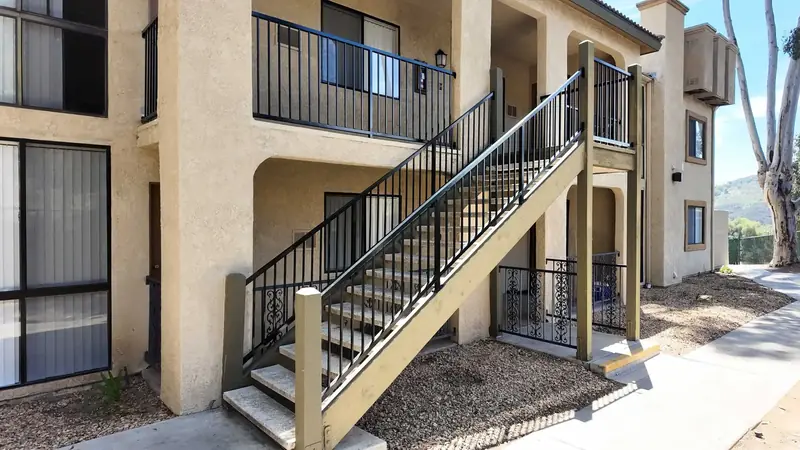
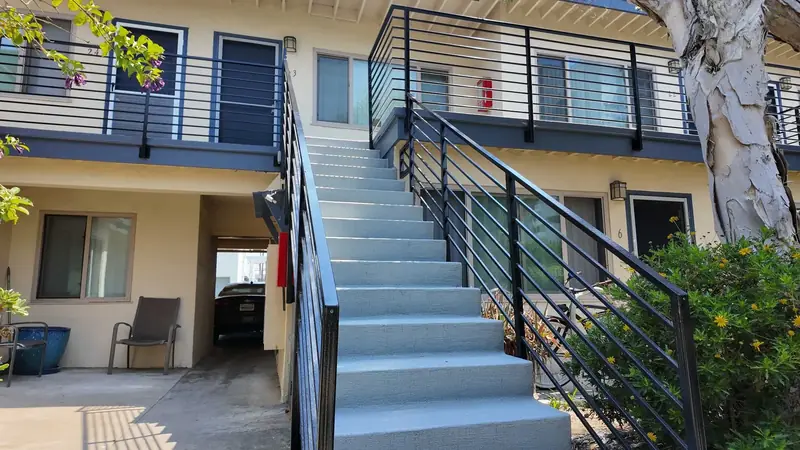
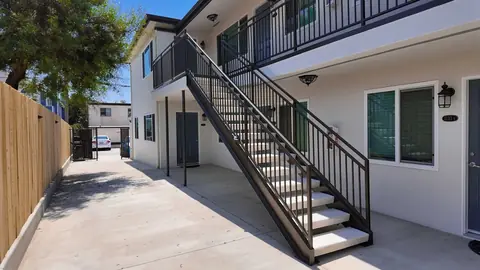
"SD Custom Iron made a railing for a circular stairway for our new house in Julian. This was quite difficult because of the tight radius. Luis did an excellent job and completed the job on time. We are very happy with the result and I would recommend this company to anybody looking for quality custom iron work at a reasonable price."

Commercial Exterior Metal Stairs for San Diego Apartment & Commercial Properties
San Diego Custom Iron Works fabricates and installs structural exterior metal stairs for apartment complexes, commercial buildings, industrial facilities, and multi-family HOA communities across San Diego County. From heavy-duty C-channel steel stringers paired with weather-resistant precast concrete treads to complete exterior egress replacements arising from inspection findings, every project is built by father-and-son fabricators Luis Lazalde Sr. and Luis Lazalde Jr. — combining 30 years of master craftsmanship with generational continuity. Explore our complete custom fabrication capabilities as a licensed C-23 San Diego stair contractor.
Replacing Commercial Exterior Stairs Across Apartments or Industrial Sites?
Plan phased stair replacements, address corroded steel stringers, or resolve city and insurance inspection findings. Work directly with Luis Sr. and Luis Jr. on code-compliant structural steel staircases throughout San Diego County.
Engineered for Property Managers, Contractors, and Commercial Owners
Multi-Family & HOA Communities
Replacing corroded, unsafe exterior walkways and stair flights on occupied two-story and three-story residential communities. We handle the structural demolition, haul-away, C-channel steel fabrication, precast tread setting, and dual-rail safety barrier installation with minimal disruption to tenant access.
- ✓ 24-to-48-Hour advance written tenant notices
- ✓ Dedicated on-site safety spotters during active crane hoisting
- ✓ Phased egress management so emergency access routes remain active
- ✓ Comprehensive before-and-after photo records for out-of-area owners
Commercial Facilities & Industrial Sites
Fabricating primary public entry stairs, mechanical penthouse access runs, loading dock stairways, and heavy-duty egress systems designed to IBC Chapter 10 and OSHA 1910.25 standards.
- ✓ IBC Chapter 10 public egress compliance (7" riser / 11" tread)
- ✓ OSHA 1910.25 industrial workplace stairways (30°–50° pitch range)
- ✓ Hot-Dip Galvanizing (ASTM A123) for marine salt-air defense
- ✓ AWS D1.1 certified shop and field structural welding
The Gold Standard for Multi-Family Egress: C-Channel & Precast Concrete Treads
When replacing exterior stairs on San Diego multi-family properties, material selection directly determines operational lifespan and maintenance overhead. Thin sheet-metal pan stairs filled with wet-poured concrete often trap moisture beneath the tread surface, leading to hidden internal rust and early structural failure.
Our primary specification for commercial multi-family exterior stairs pairs structural steel C-channel stringers with heavy-duty precast concrete treads:
- Structural C-Channel Steel Stringers: Fabricated from heavy-gauge structural channel (C-channel or MC-channel) with thick steel angle brackets welded directly to the interior web. In accordance with NAAMM AMP 510 and AISC structural steel standards, all main stringer runs are shop-fabricated from continuous, single-piece steel sections without weak field-welded splices across clear spans.
- Precast Concrete Treads: Engineered precast concrete tread slabs bolt securely into the heavy welded angle brackets. Precast treads deliver a solid, whisper-quiet walking surface under heavy foot traffic while eliminating the noise and water-ponding vulnerabilities of hollow metal pans.
- Individual Tread Replaceability: If a single concrete tread is ever damaged by extreme impact, it can be unbolted and replaced individually in less than an hour — eliminating the need to demolish or re-weld the entire structural flight.
- Positive 2% Surface Water Discharge: Every tread angle bracket is set with an exact 2% (1:48) forward cross-slope per IBC 1011.7.2, forcing rainwater to discharge cleanly over the nosing edge rather than pooling against stringer welds.
Beating Coastal Salt Air: ASTM A123 Galvanizing & Marine Hardware
San Diego’s coastal climate presents severe environmental challenges for exterior steel structures. Atmospheric airborne chlorides, high relative humidity, and UV exposure rapidly oxidize unprotected carbon steel, causing paint flaking, base-plate rot, and structural section loss.
- Hot-Dip Galvanizing (ASTM A123): Completed raw steel stringers, landing frames, and guardrail sections are fully submerged in a molten zinc bath at 840°F (450°C), creating an iron-zinc alloy layer capped by pure zinc. This creates a 30 to 50+ year protective zinc barrier against salt-air corrosion, even in coastal environments.
- Architectural Powder Coating (AAMA 2604 Spec): When custom color matching is required for commercial building facades, we apply Super Durable Architectural Powder Coating over galvanized or prepped steel to resist UV chalking, salt spray, and scratching.
- Dissimilar Metal Galvanic Isolation: Where steel stringers connect to aluminum handrails or stainless brackets, we install heavy-duty non-conductive neoprene isolation shims to prevent electrochemical galvanic oxidation.
- Type 316 Stainless Hardware Standard: All mechanical expansion bolts and anchor rods installed within coastal zip codes are specified in Type 316 marine-grade stainless steel to resist rust and prevent corrosion staining on adjacent concrete.
Building Code Standards (IBC, OSHA, ADA) & Fall Biomechanics
Building codes for commercial stairways exist to prevent catastrophic falls and ensure rapid, unobstructed egress during emergency evacuations.
| Compliance Metric | IBC Chapter 10 (Public & Multi-Family Egress) | OSHA 1910.25 (Industrial & Workplace Access) |
|---|---|---|
| Maximum Riser Height | 7.0 inches (18.0 cm) max | 9.5 inches (24.1 cm) max |
| Minimum Tread Depth | 11.0 inches (28.0 cm) min | 9.5 inches (24.1 cm) min |
| Dimensional Uniformity | Max 3/8" variance across entire flight | Standard industrial tolerance |
| Minimum Clear Width | 44 inches (>50 occupants) / 36 inches (<50) | 22 inches minimum clear width |
| Maximum Vertical Rise | 12 feet (144") before intermediate landing | Landing required for extended runs |
| Headroom Clearance | 80 inches (203 cm) continuous vertical clearance | 80 inches continuous vertical clearance |
Fall Biomechanics & Slip Prevention Engineering
Safety research demonstrates that pedestrians negotiate stairways primarily by gait rhythm, visually inspecting only the top three and bottom three steps of a flight. Inconsistent step geometry causes three primary stumble mechanisms: understep (striking the riser), overstep (ball of foot slipping off nosing), and air step (completely missing a tread).
We can address these safety liabilities through three engineered features:
- 70% LRV High-Contrast Visual Warning Bands: ADA-compliant 2-inch wide Safety Yellow abrasive bands embedded into tread nosings, providing immediate edge detection under overcast or low-light conditions.
- Nosing Radius Control: Tread nosings feature a precise 0.5-inch maximum radius of curvature, preventing sharp catching edges while eliminating excessive slope that causes foot roll.
- Absolute Chemical Deicing Salt Prohibition: Chemical deicing salts (sodium chloride, calcium chloride) destroy protective coatings and rapidly rot steel framing. We instruct property managers to rely strictly on clean sand or mechanical sweeping for winter traction.
Integrated Guardrail & Graspable Handrail Safety Assemblies
Commercial outdoor stairways require two separate safety barriers working in unison: a 42-inch high structural guardrail to prevent high-level perimeter falls, and a lower 34-to-38-inch graspable handrail for continuous physical leverage during travel.
- 42-Inch Structural Guardrails: Installed along all open sides elevated more than 30 inches above grade. Built to withstand a 200 lb concentrated point load applied in any direction, or a 50 lb/linear foot uniform load.
- 4-Inch Sphere Infill Rule: Vertical balusters, mesh panels, or cable infill restrict passage of a 4-inch diameter sphere up to 34 inches, and a 4-3/8 inch sphere from 34 to 42 inches. Cable systems feature rigid end posts and heavy tensioning to prevent deflection beyond 4 inches under pressure.
- 34-to-38-Inch Graspable Handrails: Mounted continuously along both sides of the stairway (and intermediate positions for stairs wider than 75 inches). Features a Type I circular profile (1.25" to 2.0" OD) or graspable non-circular profile with 1.5 inches of clear wall clearance and 12-inch horizontal top extensions that return smoothly into walls or posts.
Knowing When to Repair vs. When to Replace Commercial Exterior Stairs
During our on-site evaluation, we assess the condition of existing steel framing and treads to determine the safest, most practical solution based on visible corrosion and your property's inspection findings:
Candidates for Spot Metal Repair
Surface rust on handrails, localized tread brackets with minor surface oxidation, or individual cracked precast concrete treads where the main C-channel stringer retains solid wall thickness.
Individual concrete treads can be unbolted and replaced in under an hour without disturbing the structural steel frame.
Criteria for Full Flight Replacement
When structural corrosion penetrates the primary steel stringer web or when base-plate anchors lose solid concrete embedment, localized spot welding is often insufficient to restore structural integrity.
In these severely compromised cases, replacing the flight with a new C-channel steel stair assembly restores safety to your property's exterior egress.
What Property Managers, Contractors & Homeowners Say
Read how Luis Sr., Luis Jr., and our certified crew deliver meticulous iron craftsmanship, prompt communication, and dependable service across San Diego County.
Frequently Asked Questions About Exterior Metal Stairs
Clear, expert answers to common commercial stair engineering, cost, and code questions.
How long does a commercial exterior metal stair replacement take?
Most multi-family exterior stair replacements are completed in 3 to 5 business days on site following shop fabrication. On-site demolition and structural C-channel stringer erection typically take 1 to 2 days, followed by precast tread setting and handrail anchoring. Shop fabrication and hot-dip galvanizing require 2 to 3 weeks prior to jobsite mobilization.
Why are precast concrete treads preferred over steel pan treads for apartments?
Precast concrete treads provide a solid, whisper-quiet walking surface that eliminates the hollow metallic clatter of steel treads. More importantly, precast concrete treads do not trap standing water beneath sheet-metal pans, preventing the hidden underside rust that causes premature pan failure. If a precast tread is ever damaged, it can be unbolted and replaced individually in less than an hour.
What is the difference between IBC and OSHA stair standards?
IBC Chapter 10 governs public commercial and multi-family egress stairs, enforcing a strict 7-inch maximum riser height, 11-inch minimum tread depth, and 44-inch minimum clear width. OSHA 1910.24 governs private industrial workplace stairs (factory floors, equipment platforms), allowing steeper 9.5-inch risers and 9.5-inch treads on compact 30° to 35° inclines.
Do you handle the structural metal scope identified in SB 721 or SB 326 findings?
Yes. While San Diego Custom Iron Works does not perform statutory inspections or issue inspection reports, we specialize in fabricating and installing the corrective structural metalwork, steel stringers, precast treads, and code-compliant guardrails specified in your engineer's or inspector's corrective report.
How do you protect exterior steel stairs from rusting near the ocean in San Diego?
For coastal properties, we recommend ASTM A123 hot-dip galvanizing, which bonds a protective zinc alloy layer to the steel that resists salt-air corrosion for 30 to 50+ years. We also use Type 316 stainless steel mounting hardware and non-conductive neoprene isolation barriers to prevent galvanic corrosion between dissimilar metals.
Commercial Exterior Metal Stairs Across San Diego County
Providing turnkey fabrication, replacement, and installation for commercial properties, apartments, and HOAs in every San Diego community:
Urban Core & Metro
- • Mission Hills
- • Hillcrest
- • Downtown San Diego
- • North Park & South Park
- • Pacific Beach & Ocean Beach
- • Point Loma & Bankers Hill
Coastal North County
- • La Jolla
- • Del Mar
- • Solana Beach
- • Encinitas & Leucadia
- • Carlsbad
- • Oceanside
Inland & East County
- • El Cajon (Shop Location)
- • Poway & Rancho Bernardo
- • Rancho Santa Fe
- • Escondido & San Marcos
- • La Mesa & Mt. Helix
- • Santee & Lakeside
South Bay & Industrial
- • Chula Vista & Eastlake
- • National City
- • Imperial Beach
- • Sorrento Valley Tech Corridor
- • Miramar Industrial Park
- • Otay Mesa Commercial Zone
Work with a Multi-Generational Metal Stair Contractor
Luis Lazalde Sr. started working in his father’s metal shop at 13, continuing a documented lineage through generations of “Herrera” — the Spanish trade designation for metalworker. Today, working alongside his son Luis Lazalde Jr., the family brings dual quality control, certified structural welding, and generational continuity to every project. We visit your property across San Diego County for precise laser measuring, code clearance verification, and accurate written estimates within 24–48 hours.